Aircon Repair vs Replacement: When to Repair, When to Replace
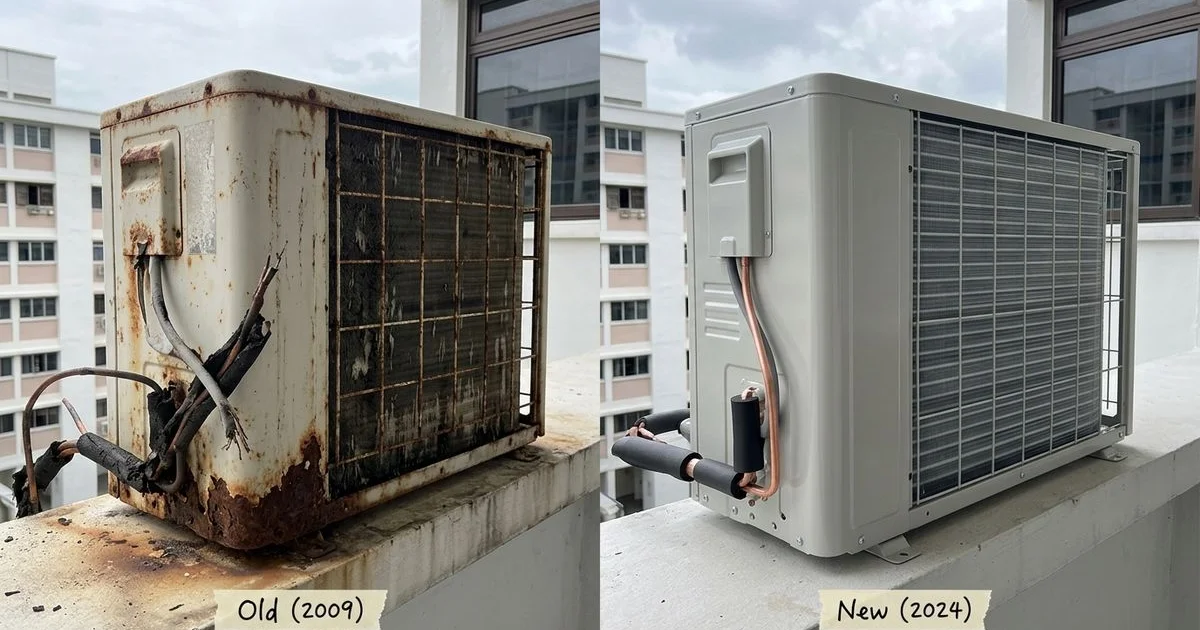
You know how quickly a faulty air conditioner can turn a comfortable Singapore flat into an unbearable sauna. Our team helps homeowners tackle the stressful aircon repair vs replacement decision every single day across local HDBs and condos, and our Aircon Repair Services team is on standby when you need a second opinion.
Making the call often feels like a gamble with your household budget.
Rising SP Group electricity tariffs and strict new environmental regulations have completely changed the financial math for 2026. We will break down the numbers, see how they impact your cooling budget, and answer the question on every homeowner’s mind: should I replace aircon hardware now or hold off?
The 50% rule for aircon repair vs replacement, and when it doesn’t apply
The standard guideline states that if a repair quote equals 50% or more of a new unit’s installed cost, you should replace the system. We always advise applying this straightforward formula to quickly evaluate expensive service quotes. When facing a fix or replace aircon dilemma, any repair bill crossing that halfway mark is a massive red flag.
For a typical System 2 in Singapore, a new replacement costs around $1,400 to $2,200 installed. Any repair quote over $700 to $1,100 starts pointing heavily to a brand new unit.
Three specific factors shift this equation:
Age of the Existing Unit
A costly repair on a three-year-old system is usually still a logical investment. Our technicians find that fixing a 13-year-old compressor is almost never worth the money. Systems past the decade mark suffer from natural wear that invites a cascade of future breakdowns.
The Phase-Out of Older Refrigerants
The National Environment Agency banned the import of older cooling gases, making them increasingly scarce. We see this impacting repair bills directly as sourcing parts becomes harder. For instance, R22 units face rapidly rising gas top-up costs that tilt the math to a replacement much earlier.
Rising Electricity Tariffs and Efficiency
A modern 5-tick unit can save a household $300 to $500 a year compared to an old 2-tick model. Our installation data shows that eligible HDB owners can also use the 2026 NEA Climate Vouchers to claim $300 off a new highly efficient system. This combined saving effectively makes a replacement cheaper over the equipment’s lifetime.
Age thresholds in Singapore conditions
Your equipment’s aircon replacement age heavily dictates the smartest financial move. We rely on clear age brackets to guide our clients to the most cost-effective decision. Reviewing these milestones helps eliminate the guesswork from your maintenance strategy.
| Unit age | Recommendation | Justification |
|---|---|---|
| 0 to 5 years | Repair | Still under warranty for major parts like the compressor. |
| 5 to 8 years | Repair | Mid-life stage with plenty of optimal cooling years left. |
| 8 to 12 years | Depends | The 50% cost rule applies tightly here. |
| 12+ years | Lean replace | Severe efficiency loss, R22 phase-out, and part scarcity. |
| 15+ years | Replace | Outside the reasonable operational life for daily use. |
These ranges assume standard daily usage throughout the year in a typical flat. Our service records show that units placed in lightly used bedrooms might extend their functional life by three to five years. A system running continuously in a hot living room will inevitably degrade much faster.
The R22 phase-out factor
Older systems using R22 gas are now facing critical maintenance hurdles due to strict environmental bans. We advise clients that nursing an obsolete model is a losing battle against rising costs. Market dynamics have permanently shifted against these legacy machines.
Prices for this specific gas have spiked significantly, jumping from about $25 per pound a few years ago to noticeably higher rates nearing $120 for a minor top-up in 2026. Our suppliers confirm that manufacturers are completely halting the production of R22-compatible components. Any major fault on a unit past 10 years old signals the right time to plan an R32 system upgrade.
You cannot convert an existing R22 system to use R32 directly.
The operating pressures, compressor designs, and required lubricants differ entirely between the two chemicals. Our engineers stress that draining the old gas and refilling it with a new type will destroy the equipment. A full replacement remains the only viable and legal solution.
Total cost of ownership comparison
Evaluating the total cost over a five-year period reveals the true financial impact of keeping an aging system. We use this long-term projection to help homeowners see beyond the immediate price tag of a repair. Taking a multi-year view clarifies the best path forward.
Take a typical four-room HDB flat operating a System 3 setup as a benchmark. Our calculations highlight how newer technology quickly pays for itself.
| Scenario | 5-year total cost projection |
|---|---|
| Keep 12-year-old 2-tick, ongoing repairs | $3,500 to $5,000 (repairs plus higher electricity bills) |
| Replace with new 4-tick System 3 | $4,500 ($3,000 install plus $1,500 5-yr bill savings) |
| Replace with new 5-tick System 3 | $5,500 ($3,500 install plus $2,000 5-yr bill savings) |
The 4-tick upgrade roughly breaks even with continued repairs over a five-year stretch. Our clients often appreciate that they gain a brand new, reliable setup at year five instead of fighting with a 17-year-old liability.
Investing in a 5-tick setup carries a higher initial cost but delivers the best monthly relief from rising energy tariffs.
When to repair anyway
Certain personal circumstances justify fixing a unit even when the financial math leans heavily to a replacement. We completely support taking the repair route if it aligns better with your immediate reality. Practical constraints often override pure efficiency calculations.
Consider these common scenarios where patching things up makes sense:
- An imminent move: You plan to sell the flat soon and will not stay long enough to recover the installation cost.
- Cash flow constraints: A $150 minor fix is simply what fits your household budget this month, rather than a $3,000 system overhaul.
- Brand attachment: Your existing model has been remarkably reliable for years, and you prefer to defer a major change.
These are entirely valid reasons to hold off on a massive purchase. We will always quote the required repair honestly and perform the work, even when the data suggests a different approach.
If you decide an upgrade is the best move, comparing current market rates is your next logical step. Our team maintains a detailed breakdown of aircon installation cost ranges by system size. You can also explore the specific math on individual components before committing to a full replacement by reading our PCB, capacitor, compressor diagnosis guide.
Making the final choice boils down to your budget, your timeline, and your comfort. We encourage you to reach out for a professional diagnostic if you are still unsure. A thorough inspection will help you settle your aircon repair vs replacement debate with absolute confidence.