Aircon PCB, Capacitor, or Compressor — How to Tell What's Failing
You probably run your air conditioning for about eight hours a night to battle the constant Singapore heat.
This heavy daily usage pushes internal components to their absolute limits. We see these systems break down frequently under the strain of our tropical climate. That constant operation is exactly why an aircon part failure becomes a common reality for many homeowners.
So, let’s explore the data behind an aircon pcb capacitor compressor replacement and look at practical ways to respond.
The three parts that fail most
Most aircon faults beyond the basics, like a blocked filter or a dirty drainage pipe, trace back to one of three components. These are the capacitor, the PCB, or the compressor.
Knowing which part is failing from the symptoms saves diagnostic time and helps you understand the repair quote. We find that identifying the exact fault early prevents a small electrical issue from destroying the entire system.
Understanding these three components gives you a clear advantage when authorising any aircon component repair.
Capacitor failure
The capacitor acts like a temporary battery that stores and releases a massive burst of electrical energy. This 200V to 450V jolt is what starts the compressor and the fan motors.
When this component weakens, those critical motors hesitate or fail to start completely. Our technicians frequently replace run capacitors that have swollen or leaked due to the extreme outdoor heat.
You can often spot the warning signs before a complete shutdown occurs.
Symptoms:
- Humming sound from the outdoor unit with no fan spin
- Hard starts, featuring lurching or jerky engagement
- Intermittent starts and sudden stops
- The outdoor condenser remains silent while the indoor blower is on
Cost in Singapore: A replacement typically costs between $80 and $200. We carry common OEM capacitors on the van, allowing for a fast same-visit repair. This price includes the part and the labour required to install it safely.
Lifespan and Insider Tips: Expect an average lifespan of 5 to 8 years for a standard capacitor. Heavy-use commercial setups and residential units exposed to direct afternoon sun see much faster failure rates.
A massive drop in the microfarad (µF) rating is the most common cause of a motor failing to start. You should never try to test this component yourself, as it stores a lethal electrical charge even when the power is disconnected.
PCB (Printed Circuit Board) failure
The indoor PCB is the main control board, acting as the brain of your entire cooling setup. It handles communication with the outdoor unit, processes sensor readings, controls the fan speed, and logs error codes.
When the board fails, the resulting symptoms are highly erratic and unpredictable. Our diagnostic process always includes checking this board for signs of electrical burns or moisture damage.
Replacing an inverter PCB is complex, but it restores full functionality to the system.
Symptoms:
- Error codes flashing on the display (Daikin U4/A1, Mitsubishi E1/E6, Panasonic H11)
- Intermittent power-on cycles
- Complete loss of remote control response
- Wrong temperature behaviour and erratic cooling
- Communication faults between the indoor and outdoor sections
Cost in Singapore: You can expect to pay $150 to $400 for a typical repair. This price range reflects the standard aircon pcb cost across most residential brands in the market today. Some specific brand PCBs, especially those found in newer high-efficiency inverter models, run significantly higher.
Lifespan and Common Hazards: These boards average a 7 to 10 year lifespan under normal conditions. Power surges shorten this dramatically, and a two-second voltage spike from your building can instantly destroy the sensitive electronics.
We also see a surprising number of failures caused by geckos. These small house lizards seek out the warmth of the outdoor circuit board. When they crawl across the live connections, they create a catastrophic short circuit that fries the board instantly.
Compressor failure
The compressor is the heart of the refrigerant cycle, responsible for pumping the cooling gas through the pipes. It is also the single most expensive component to replace and the strongest indicator that a unit is reaching its end of life.
A modern inverter compressor operating with R32 refrigerant operates under immense pressure. We handle these replacements carefully to ensure strict environmental compliance and system safety.
Symptoms:
- Warm air output due to a lack of refrigerant compression
- Loud, grinding start-up noises from the outdoor unit
- The compressor does not engage at all
- Tripping the main HDB electrical breaker upon start-up
- Recurrent overheating and sudden shutdowns
Cost in Singapore: A full replacement costs $500 to $1,000 or more. This price includes refrigerant recovery, the new part, a recharge with fresh gas, and extensive labour. Costs run even higher for commercial VRV or VRF setups.
Lifespan and Replacement Logic: A well-maintained compressor lasts 10 to 15 years on average. Past the 10-year mark, a major failure often means it is time to consider replacement instead of repair.
Upgrading to a newer model with a 5-tick NEA energy rating often makes more financial sense than replacing a dead compressor in a decade-old system.
Diagnosis matrix
A structured approach eliminates guesswork and gets your cooling back faster. We use this exact priority list to check your system when you report these faults.
Identifying the root cause quickly keeps diagnostic time low and ensures an accurate quote.
| Symptom | Most likely fault | Next likely fault |
|---|---|---|
| Humming noise, no fan spin | Blown capacitor | Seized fan motor |
| Error code visible on display | Damaged PCB | Faulty thermistor sensor |
| Warm air, no actual cooling | Dead compressor | Severe refrigerant leak |
| Lurchy, jerky start-up | Weak capacitor | Compressor early failure |
| No response to remote control | Fried PCB | Dead remote battery |
| Trips the electrical breaker | Shorted compressor | Melted wiring or insulation |
Avoiding wrong-part replacement
The most expensive mistake any homeowner can make is paying to replace the wrong part. Symptoms frequently overlap, and a humming unit might just be a cheap capacitor fix or a very expensive early-stage compressor failure.
We rely on strict diagnostic testing to isolate the real issue before quoting a price. Proper testing protects your wallet and guarantees a permanent fix.
To ensure accuracy, our technicians always follow these exact steps:
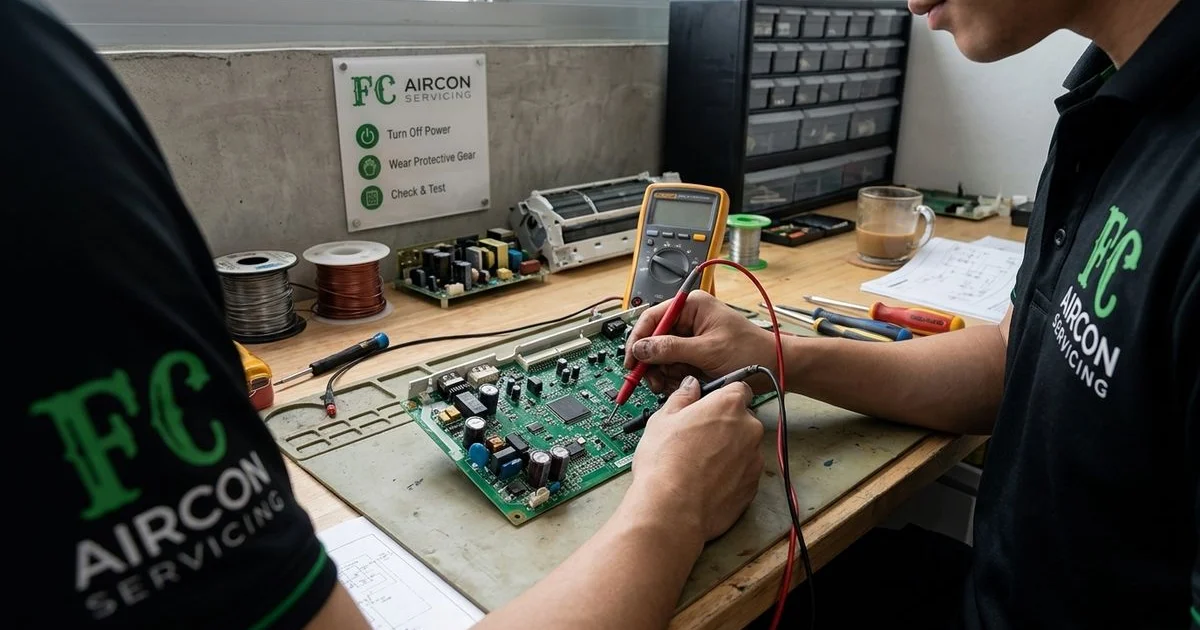
- Use a digital multimeter to test the capacitor’s microfarad rating before swapping it.
- Pressure-test the R32 or R410A refrigerant lines with manifold gauges before suspecting a dead compressor.
- Read the internal PCB error log to pinpoint communication faults before replacing the entire board.
That systematic approach is why an accurate diagnosis is its own distinct step before any physical work begins.
The standard $40 base call-out fee covers this comprehensive testing phase.
For the broader decision on what to do when part costs get too high, see our detailed breakdown on aircon repair vs replacement.
For ongoing problems where multiple parts have failed in the last year, our emergency repair page walks through the complete inspection process.