Common Aircon Error Codes for Daikin, Mitsubishi & Panasonic
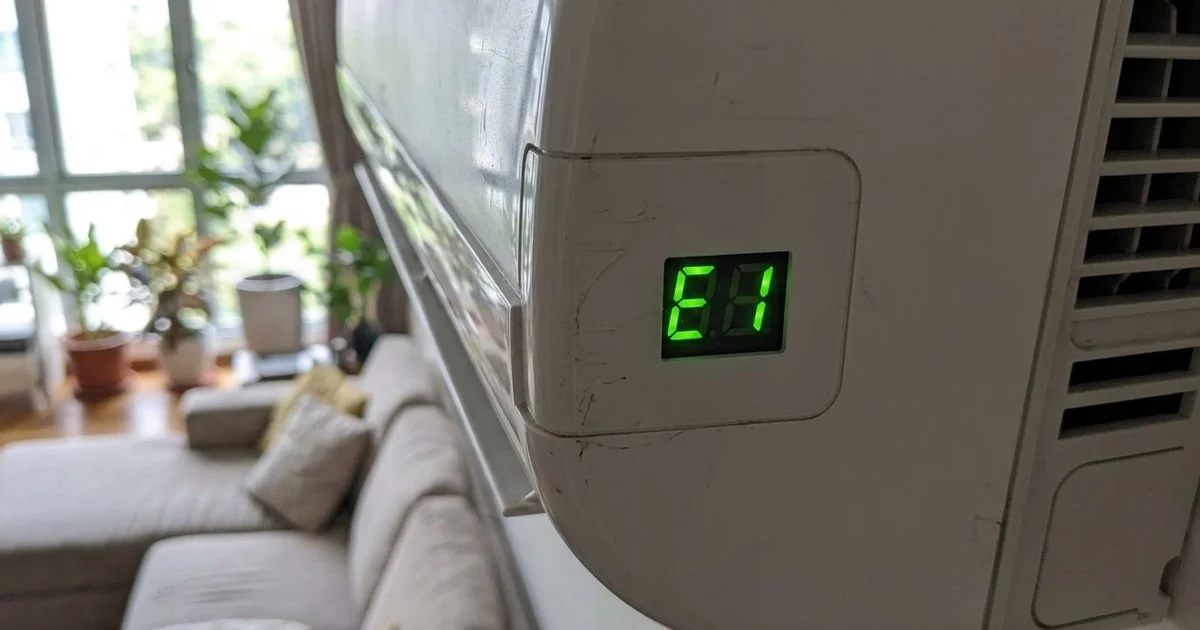
How aircon error codes work
When diagnosing aircon error codes singapore homeowners often discover that a simple blinking light is their only clue. Modern aircon units have onboard diagnostics that flash a specific code on the indoor display when they detect a fault.
Older units use LED blink patterns instead of alphanumeric codes. You simply count the flashes between pauses to identify the problem.
Either way, the code points to a specific subsystem like the refrigerant or the control board rather than diagnosing the fault itself. Our team uses this exact indicator as the starting point for troubleshooting.
For emergency repair dispatch, tell us the brand, the code, and how long it has been showing. That lets us bring the exact right replacement parts on the first visit.
Let’s explore what the data is actually telling us and walk through a few practical ways to respond.
Daikin error codes (most common in Singapore)
Daikin systems display a specific daikin error code to indicate exactly where the system is failing. These alphanumeric sequences cover everything from a minor sensor glitch to a severe circuit board malfunction.
Retrieving Codes via Remote
Many homeowners do not realise they can diagnose their own Daikin unit directly from the couch. Point your remote at the indoor unit and hold the cancel button for about five seconds.
A double zero will flash on the screen. Press the button repeatedly until you hear a long continuous beep.
This final code on the screen is your exact problem.
Common Daikin Faults
| Code | Meaning | Severity | Action |
|---|---|---|---|
| U0 | Low refrigerant | Medium | Pressure test, leak detection, then top-up |
| U4 | Indoor/outdoor communication | High | Wiring check, PCB diagnosis |
| A1 | Indoor control board fault | High | PCB replacement, S$200 to S$400 |
| C4 | Heat exchanger sensor | Low | Sensor replacement, S$80 to S$120 |
| H8 | Outdoor temperature sensor | Low | Sensor replacement |
| F3 | Discharge temperature high | High | Refrigerant pressure check, possible compressor |
The Infamous U4 Error
The U4 code is the one we see most often during the monsoon season. Moisture intrusion between the indoor and outdoor wiring causes this critical communication fault.
Replacing a burnt printed circuit board for this issue usually costs between S$200 and S$400 in 2026. Prompt action prevents this electrical short from permanently damaging your expensive compressor.
Mitsubishi (Starmex) aircon error codes Singapore
Mitsubishi Starmex multi-splits use a mitsubishi aircon error code to signal precise operational failures. These codes help pinpoint whether the system is suffering from a communication breakdown or a simple drainage blockage.
Diagnosing HDB Drainage Issues
Mitsubishi systems sometimes show errors on the master indoor unit that originate at a completely different head. Diagnosis can take a little longer to localise across multiple rooms.
We frequently encounter the P5 error code in older HDB flats. Algae and jelly accumulate in the drainage pipes from continuous everyday usage.
This buildup blocks the drain pump and triggers the safety fault.
Repair Costs and Warranties
Our technicians note that Mitsubishi replacement parts run slightly higher than average. Fixing an E6 indoor and outdoor communication error requires replacing the circuit board, which costs around S$200 to S$350.
High-end models often carry a five-year warranty. This solid coverage can completely offset these repair expenses if your unit is still relatively new.
| Code | Meaning | Severity | Action |
|---|---|---|---|
| E6 | Indoor/outdoor communication | High | Wiring or PCB replacement (S$200 to S$350) |
| P8 | Indoor temperature sensor | Low | Sensor replacement |
| E1 | Indoor control PCB | High | PCB replacement |
| P5 | Drain pump abnormal | Medium | Drain pump check, drainage clear |
| U2 | Power supply abnormality | High | Electrical isolation, breaker check |
Panasonic (nanoe-G) error codes
A panasonic error code provides an immediate warning when critical electrical components begin to fail. Spotting an H11 or F90 code tells you right away that the system requires professional electrical testing.
| Code | Meaning | Severity | Action |
|---|---|---|---|
| H11 | Indoor/outdoor communication | High | Wiring or PCB replacement |
| H99 | Defrost sensor | Low | Sensor replacement |
| F11 | Reversing valve fault | High | Valve diagnosis |
| F90 | Power factor correction | High | Outdoor PCB replacement |
| H97 | Outdoor fan motor | Medium | Motor replacement, S$200 to S$400 |
Dealing with Circuit Board Failures
The H11 code signals an abnormal communication loop between the indoor and outdoor units. Faulty wiring or a damaged printed circuit board usually causes this specific disruption.
Power surges from frequent lightning storms often fry these sensitive electronic boards in Singapore.
Servicing Panasonic Sensors
If your aircon features the Econavi sensor, erratic cooling behaviour might mean the component requires calibration. Turning the Econavi feature off via your remote serves as a practical temporary measure.
The unit will simply run at a constant output until a technician arrives. Our standard diagnostic visit starts at S$40, while regular servicing for these models begins at roughly S$16 per unit in 2026.
Reading blink patterns (older units)
When there is no display code, older units flash a green or red LED on the indoor unit in a specific pattern. You must decode this blink sequence to identify the underlying mechanical fault.
The indicator pattern is entirely brand-specific.
- Daikin: Count flashes between long pauses; 1 to 9 equals code 1 to 9, while alternating slow and fast blinks indicate a communication issue.
- Mitsubishi: The RUN lamp and TIMER lamp blink simultaneously, requiring you to count both.
- Panasonic: The timer LED counts in five-second cycles to signal different subsystem faults.
Capturing the Sequence Accurately
We highly recommend recording the indoor unit during the blink sequence. Send us a thirty-second video clip on WhatsApp.
Our team can decode the exact sequence from the video before dispatching a van. This simple step guarantees the technician arrives with the correct diagnostic tools and replacement parts.
Reset vs call
A system reset is ideal for clearing temporary software glitches, while a service call is mandatory for persistent hardware failures. Knowing the difference prevents you from permanently damaging your compressor.
When to Reset Your Aircon
Resetting the system is appropriate for a few specific situations.
- One-off codes after a power blip or electrical surge.
- Codes that appear once on the first startup of the day.
- Communication errors that clear on their own within five minutes.
When to Call a Technician
Call us immediately for more serious indicators. Ignoring these warnings will only increase your final repair bill.
- The same code returning within 24 hours of a reset.
- Multiple different codes appearing simultaneously.
- A code accompanied by no cooling or a visible water leak.
- Anything displaying H99, F90, or F11, as those usually require immediate parts replacement.
Diagnostic and Repair Costs
The base diagnostic call-out fee is S$40, with an extra S$20 surcharge for Central Business District locations. The repair itself is quoted separately after we read the code and test the relevant component with a pressure gauge or multimeter.
We strive to provide complete pricing transparency before any work begins. For deeper context on which part the code points to, see our guide on PCB, capacitor, compressor failure.
Understanding these basic aircon error codes singapore technicians use helps you make an informed decision about fixing versus replacing your unit. Contact our dispatch team today with your specific error code, and we will get your home cooling again within hours.