R22 vs R32 vs R410A — Singapore Aircon Refrigerant Types Explained
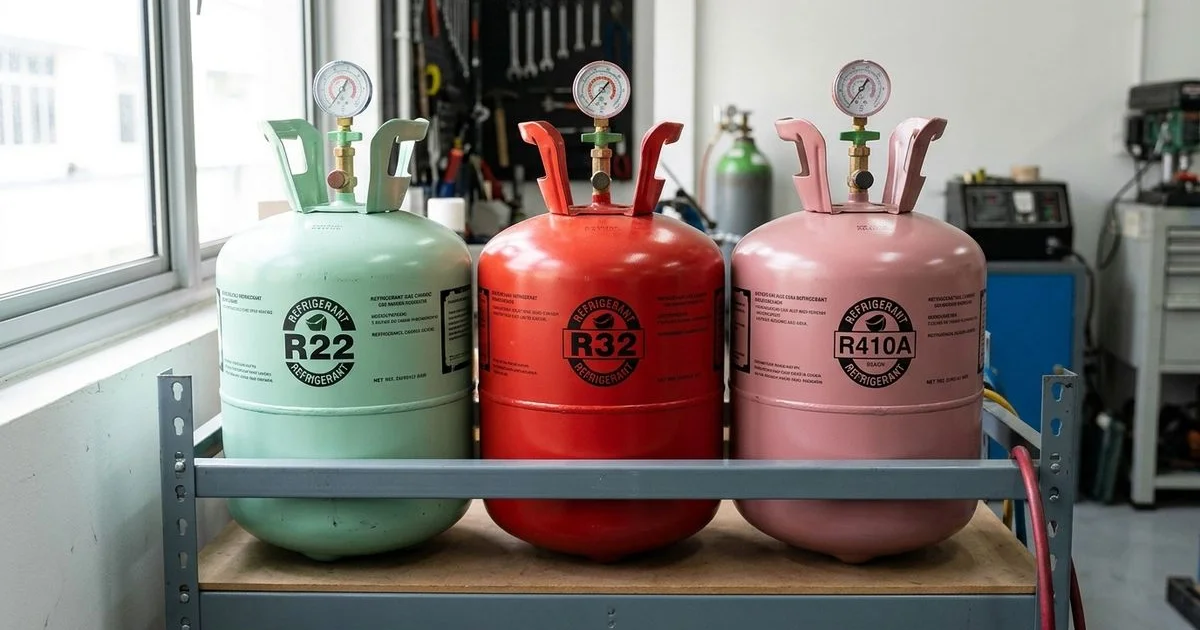
We know that most homeowners only check their aircon refrigerant when the unit suddenly stops blowing cold air. That sudden warm breeze usually signals an unexpected expense is right around the corner.
Our technicians have tracked the latest National Environment Agency (NEA) regulations for 2026. These new rules dictate that your existing system might run on a restricted chemical that is getting incredibly expensive to source.
We are going to break down the exact differences between R22, R32, and R410A aircon refrigerant options. This practical guide will help you identify your system, understand the phase-out timeline, and make smart decisions. If your unit is already short on gas, see Signs Your Aircon Needs a Gas Top-Up first.
Let’s look at the facts.
The three refrigerants in Singapore aircon
You need to know exactly what gas your system uses to make informed servicing decisions. If you are researching aircon refrigerant types, the current Singapore market essentially deals with three main generations of cooling chemicals.
R22, legacy, phased out
We rarely see older R22 systems surviving today without needing major, costly interventions. This legacy gas was the standard choice for units manufactured before 2010.
Our local industry has heavily felt the R22 phase out Singapore regulations, completely stopping new imports under the Montreal Protocol. Singapore still allows licensed technicians to service existing R22 units, but new production is strictly banned.
What this means for you:
- Top-up prices have spiked to between $60 and $120 per pound in 2026.
- Replacement parts and compatible mineral oil are rapidly shrinking in availability.
- Major service decisions on R22 units now heavily favour total replacement.
R32, current Singapore standard
We install R32 in almost every new residential aircon setup across the island. This chemical is the current Singapore standard, boasting higher efficiency than legacy options.
Our data shows these units operate at a higher pressure, meaning they need smaller pipe sizes and a lighter charge for the exact same cooling output. The NEA mandates R32 refrigerant for new single-split installations because it has a low Global Warming Potential (GWP) of 675.
This specific low GWP rating is roughly 68% better for the environment than previous generations.
What this means for you:
- Standard chemical for all new home installations.
- Most 4-tick and 5-tick energy-efficient units use R32.
- Refrigerant cost remains reasonable, and replacement parts are widely available.
- R32 models consume 10% to 15% less electricity due to excellent heat transfer properties.
R410A, mid-generation
We frequently service mid-generation units that rely on R410A gas. These reliable systems were typically installed between roughly 2005 and 2020.
Our industry originally used R410A to replace R22 globally, but it is now being slowly phased down in favour of R32. The NEA started restricting new R410A equipment in late 2022 because of its exceptionally high GWP of 2,088.
What this means for you:
- Many existing Singapore HDB and condo units still use R410A.
- Gas top-ups remain available but are noticeably pricier than R32.
- For end-of-life replacement, the brand-new unit will definitely be an R32 system.
How to check which refrigerant your unit uses
The refrigerant type is printed directly on the data plate, which is a small metal label on the outdoor condenser unit. Look closely for specific text indicators before booking a service.
We always check this label first during a routine house call. You will usually find a distinct line saying “Refrigerant: R22”, “R32”, or “R410A”.
Our technicians also check for short codes like “R-22”, “R-32”, or “R-410A” on faded condenser boxes. Newer models from March 2020 onwards might also display the green NEA Climate-Friendly Label if they run on R32.
If the label is missing, faded, or unreadable, the unit’s age gives a strong clue:
- Before 2010: Probably R22.
- 2010 to 2018: Highly likely R410A.
- 2018 onwards: Almost certainly R32 (especially for 4-tick and 5-tick units).
Switching refrigerant types, why you can’t
The three refrigerants operate at drastically different pressures and require entirely different lubricants inside the compressor. You cannot drain one gas and simply refill the entire system with another.
We see catastrophic failures when untrained people attempt to mix these specific chemicals. Putting high-pressure R32 into an old R22 system causes several rapid failures:
- Legacy compressor seals blow out immediately due to extreme pressure differences.
- Mismatched lubricants (mineral oil versus synthetic POE oil) mix and turn highly acidic.
- System pressures fall completely out of design specifications, triggering continuous gas leaks.
Our mechanical training shows that this combination leads directly to an expensive, unrepairable compressor burnout. So when your R22 unit reaches its absolute end-of-life, the only correct move is a full system replacement with an R32 unit.
Refilling the copper pipes with a different, incompatible refrigerant is never a viable workaround.
Decision math for R22 units
If you have an R22 unit needing service, the math comes down to the cost of repair versus long-term energy savings. A smart replacement strategy protects your wallet from soaring legacy gas prices.
We apply a strict 50% rule when advising customers on these older setups. If a single repair quote exceeds $500 to $600, you are paying roughly half the price of a brand-new inverter unit.
Our team uses this straightforward decision matrix for R22 systems:
| Unit age | Recommended Decision |
|---|---|
| Under 8 years | Service it, pay for an R22 top-up if absolutely needed. |
| 8 to 12 years | Service or replace depending heavily on the repair quote. |
| 12+ years | Replacement usually wins based on energy efficiency and reliability. |
| Any age with major fault | Compare repair cost directly to the price of a new unit. |
The aggressive R22 phase-out tightens this financial logic even further in 2026. For any R22 unit sitting past the 10-year mark, a major component fault is usually the perfect time to plan an R32 upgrade.
We highly recommend reviewing the detailed repair versus replace math over at our full aircon repair vs replacement guide. To quickly book a verified refrigerant check or a system top-up, head straight to our aircon gas top-up service page.
We hope this breakdown clarifies the changing landscape of cooling chemicals in Singapore.
Staying informed about these strict NEA regulations ensures you never overpay for obsolete legacy parts.
Check your outdoor condenser label today.