Inverter vs Non-Inverter Aircon — Which Actually Saves More in Singapore?
Our professional service team fields questions about climate control efficiency every single day.
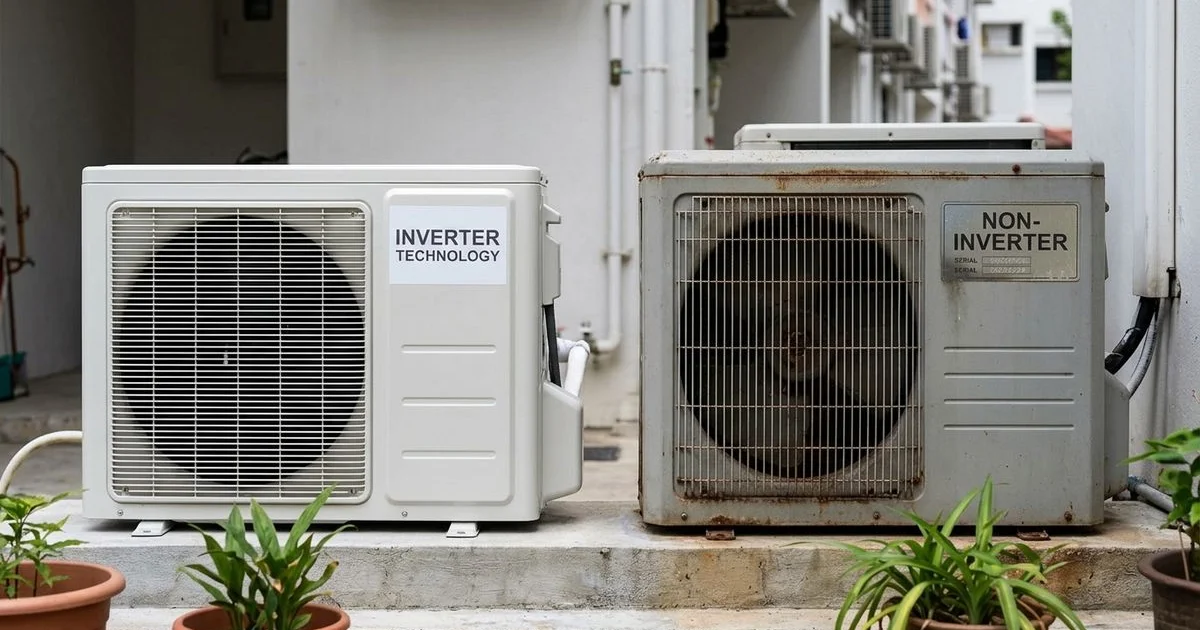
The choice of an inverter vs non inverter aircon is the biggest factor determining your monthly utility costs.
With Singapore’s SP Group electricity tariffs sitting near 30 cents per kilowatt-hour in 2026, making the wrong choice quickly becomes expensive.
We will review the performance data, explain the cost differences, and help you select the most efficient setup for your home. Once you have picked a system, our Aircon Installation team handles the BCA-compliant bracket work and commissioning. For unit-count and zoning trade-offs, see Split vs Window vs Multi-Split vs VRV.
How each works: inverter vs non inverter aircon
Our technicians find that understanding the mechanical differences clarifies the price gap. Non-inverter compressors operate on a simple fixed-speed basis. The compressor runs at 100 percent power until the room reaches the desired temperature. We see this heavy on-off cycling primarily in older HDB installations across Singapore. These repeated start-ups draw massive amounts of electricity.
Key Operational Differences
- Fixed-Speed (Non-Inverter): Operates entirely on an all-or-nothing cycle.
- Variable-Speed (Inverter): Adjusts RPM output smoothly based on real-time thermal load.
Our installation teams prefer variable-speed technology for better climate control. Inverter compressors modulate their internal revolutions per minute (RPM) dynamically. The motor starts at maximum capacity to cool the space quickly. We watch these modern systems smoothly slow down to maintain that target temperature without shutting off. This continuous, low-power operation defines most current 4-tick and 5-tick units on the market.
Why inverters save energy
Our performance tests show that variable-speed compressors reduce energy consumption by preventing power spikes. This technology easily achieves a 30 to 40 percent reduction in typical daily usage compared to fixed-speed alternatives. We attribute these massive aircon energy savings to three specific mechanical advantages.
Three Reasons for Lower Bills
- Elimination of start-up surges: A non-inverter compressor draws up to three times its running current just to turn the motor back on.
- Lower steady-state running power: An inverter drops its output down to 20 or 40 percent capacity once the target climate is achieved.
- Superior dehumidification: Continuous low-speed running pulls significantly more moisture from the air than an intermittent cycle.
Our service data confirms that maintaining a steady temperature requires far less effort than repeatedly cooling a warm room. The National Environment Agency (NEA) reports that efficient residential units can save households hundreds of dollars annually.
The dollar math over 5 years
We calculate that the upfront premium for variable-speed technology pays for itself within two to three years of standard operation. The long-term financial benefit becomes undeniable when you factor in current utility rates. Our baseline model is a standard 1.5HP unit operating for six hours every night in a Singapore master bedroom. A 2026 tariff rate of roughly 30 cents per kilowatt-hour makes the efficiency gap highly visible.
| Year | Inverter cost | Non-inverter cost | Cumulative saving |
|---|---|---|---|
| Year 0 (install) | $1,100 | $800 | -$300 |
| Year 1 (bills) | $440 | $640 | -$100 |
| Year 2 (bills) | $440 | $640 | +$100 |
| Year 3 (bills) | $440 | $640 | +$300 |
| Year 5 (bills total) | $2,200 | $3,200 | +$700 |
We consider the period after month 36 to be pure profit for the homeowner. A fixed-speed system simply bleeds money through wasted electricity every single night.
NEA Tick Rating link
Our team relies on the NEA tick rating because it accurately reflects the superior manufactured efficiency of variable-speed compressors. Almost every single 4-tick and 5-tick unit approved for sale in Singapore features this modern technology. We explain to clients that the evaluation process uses the Cooling Seasonal Performance Factor (CSPF) to measure real-world performance across varying daily temperatures. This metric provides a much more accurate picture than the outdated fixed-condition EER tests.
Our technicians advise that picking a 5-tick model effectively guarantees you are buying an advanced inverter system. These top-tier units use eco-friendly R32 refrigerant to maximize cooling capacity while minimizing environmental impact. We frequently see that this pairing of R32 gas and variable-speed motors compounds your monthly financial savings. Lowering your carbon footprint directly aligns with lowering your monthly utility bills.
When non-inverter still makes sense
We still recommend fixed-speed units for specific situations where initial capital is tight or usage is extremely low. These older designs serve a practical purpose in a few distinct scenarios. Our technicians highlight four main cases where avoiding the premium price tag is the right call.
Situations Favoring Fixed-Speed Models
- Occasional use: A payback period stretches past seven years if the machine runs for under two hours daily.
- Strict budget constraints: A basic $800 fixed-speed unit provides immediate relief if an $1,100 model is currently unaffordable today.
- Matching existing infrastructure: Replacing one unit in a non-inverter system requires matching compressor types.
- Holiday properties: The upfront hardware price matters more than efficiency when the space is only occupied for 30 days a year.
We must issue a strong warning about refrigerant compatibility when replacing partial systems in older HDB flats. A contractor cannot pump modern R32 gas into piping designed for older R410A non-inverter systems without severe safety risks. Our data shows that for 95 percent of local homes upgrading their primary climate control, the variable-speed option is strictly better. The long-term return on investment simply outweighs the initial savings for daily users.
Inverter brands in Singapore
We service all the major hardware manufacturers supplying high-efficiency climate solutions to the local market. Every leading brand currently offers outstanding variable-speed variants built for residential needs. Our maintenance crews frequently handle the following popular systems.
Top Performers in the Market
- Daikin: The i-Smile Eco+ series is a local favorite, featuring smart WiFi controls and advanced Steamer Technology for air purification.
- Mitsubishi Electric: The Starmex line remains legendary for easy maintenance, requiring the removal of just two screws to access the internal blower.
- Panasonic: The XU series utilizes nanoe-X technology to actively suppress pollutants and odors while cooling.
- Midea: This brand provides excellent entry-level variable-speed units that deliver solid performance at highly competitive price points.
- York and Toshiba: Both companies offer comprehensive ranges suitable for various room sizes and layouts.
We remain completely brand-neutral and will expertly handle the aircon installation for whichever system you choose. Your exact floor plan and personal budget will dictate which specific model provides the highest value.
Conclusion
We know that selecting the right equipment feels like a heavy financial decision.
The choice between an inverter vs non inverter aircon always comes down to your daily usage habits.
Our team is ready to assess your layout and provide a clear, customized quotation.
Contact us today to schedule your site survey and start saving money on your monthly cooling costs.