Aircon System 1, 2, 3, 4, or 5 — Which Configuration Fits Your Home?
Getting your cooling setup right is the line between a comfortable living space and shocking monthly utility bills.
We see many homeowners struggle to decode the terminology used by local contractors.
With SP Group’s 2026 electricity tariffs hitting 29.72 cents per kilowatt-hour, choosing the perfect aircon system 1 2 3 4 5 layout is a financial priority.
Let’s look at the data, clarify what these terms actually mean, and map out the best aircon configuration singapore for your property.
What “System” actually means
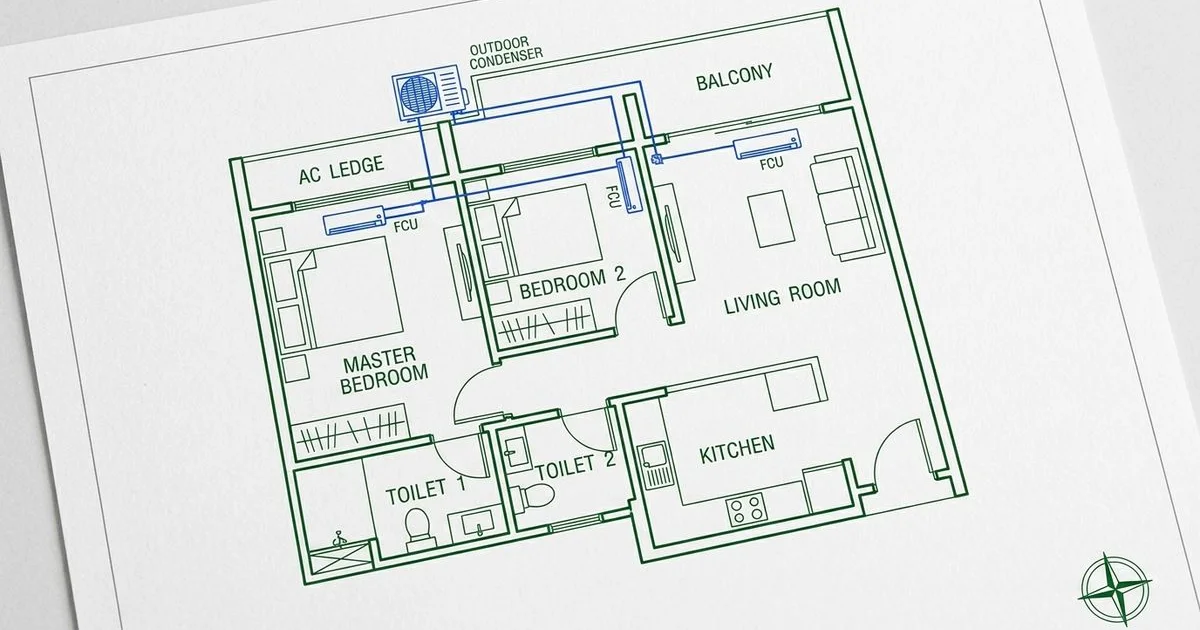
Singapore aircon terminology is straightforward once you know the core rule. The word “System” simply refers to the number of indoor units served by a single outdoor condenser.
Here is the standard breakdown:
- System 1: 1 outdoor + 1 indoor (single split)
- System 2: 1 outdoor + 2 indoor (typical 3-room HDB)
- System 3: 1 outdoor + 3 indoor (typical 4-room HDB)
- System 4: 1 outdoor + 4 indoor (typical 5-room HDB, large condo)
- System 5: 1 outdoor + 5 indoor (large condo, landed)
For multi-split installations, all indoor units share one outdoor condenser via branched refrigerant lines.
Our team frequently installs popular multi-split models like the Daikin iSmileEco or Mitsubishi Starmex R32 to maximise space on restricted HDB aircon ledges. These branched lines require careful trunking planning during renovation.
That is exactly what “System X” implies. It is a multi-split configuration designed to cool several rooms efficiently without cluttering your exterior walls.
Property type → System fit
Matching your home to the right equipment prevents overworked compressors and uneven temperatures.
| Property | Default System |
|---|---|
| Studio / 1-room HDB | System 1 |
| 3-room HDB | System 2 |
| 4-room HDB | System 3 |
| 5-room HDB / Executive HDB | System 3 or 4 |
| Small condo (1 bed) | System 1 or 2 |
| Mid condo (2 bed) | System 2 or 3 |
| Large condo (3+ bed) | System 3, 4, or 5 |
| EC (Executive Condo) | System 4 or 5 |
| Landed (small) | System 4 + |
| Landed (large) | Multiple Systems or VRV/VRF |
These are defaults based on typical floor plans. Actual sizing depends heavily on room areas, afternoon sun exposure, and how many rooms you actively cool at the same time.
Assessing HDB and BTO Layouts
Newer 2026 BTO flats in areas like Tengah or Punggol have distinct layouts that influence your choice. We find that a standard 4-room flat usually sits around 90 square metres. This layout makes a System 3 the ideal baseline for cooling the master bedroom and two common rooms.
If you want a system 2 aircon hdb setup, it usually means you are only chilling the master bedroom and the central living area.
Planning Your Trunking Route
Condensers require PVC trunking to house the copper pipes and electrical wires. You must consider the drainage route to the nearest bathroom to prevent future leaks. Older resale flats often require longer trunking paths compared to modern BTOs with pre-planned exterior ledges.
BTU sizing rule of thumb
Each indoor unit has a BTU (British Thermal Units) rating that determines its cooling capacity. Getting the btu sizing aircon right is crucial for Singapore’s tropical climate.
Here is the basic calculation:
- 500-600 BTU per sqm for typical rooms (low afternoon sun)
- 600-700 BTU per sqm for rooms with west-facing sun
- 700-800 BTU per sqm for kitchens (heat load from cooking)
Typical units in Singapore:
- 9,000 BTU (1HP): Single bedroom, up to 14 sqm
- 12,000 BTU (1.5HP): Master bedroom or small living room, up to 18 sqm
- 18,000 BTU (2HP): Large living room or open-plan area, up to 28 sqm
- 24,000 BTU (2.5HP): Large open-plan living/dining, up to 38 sqm
For a typical 4-room HDB living room (about 15 sqm), 12,000 BTU is the sweet spot. Master bedrooms (about 10 sqm) use 9,000 or 12,000 depending on sun exposure.
Factoring in Airflow and Heat Sources
Modern units feature advanced 3D airflow sensors that help distribute cooling more evenly across a wide space.
Our technicians always factor in open-concept layouts during home assessments. If you have an open kitchen, the latent heat from cooking means you must upgrade your living room unit’s capacity by at least one tier to compensate.
When to oversize vs undersize
Don’t oversize. An oversized unit short-cycles by cooling the air too fast and shutting down before removing the ambient moisture. This wastes electricity and leaves the room feeling clammy and uncomfortable.
Pro Tip: A perfectly sized unit runs long enough to act as an effective dehumidifier. This moisture removal is vital given Singapore’s frequent 80% relative humidity.
Don’t undersize. An undersized unit runs continuously trying to catch up. The compressor never rests, which means it never fully cools the room and wears out mechanical parts much faster.
When in doubt, size to the room area at the standard 500-600 BTU/sqm. We measure the exact dimensions during our initial site survey and confirm the heat load before quoting the final installation.
Which compressor type to pick
Within any System, you choose an inverter or non-inverter model. For Singapore conditions where the aircon runs many hours daily, inverter technology wins easily on lifetime cost. See inverter vs non-inverter aircon for the detailed bill math.
The NEA Energy Efficiency Advantage
The National Environment Agency (NEA) rates appliances using a rigid tick system. We strongly recommend selecting 5-tick inverter models running on newer R32 refrigerant. These premium units cost slightly more upfront but can save a household significant money annually on electricity compared to older 3-tick models.
For a sizing quote on your specific property, see aircon installation. We perform a comprehensive site survey and recommend the right system number plus the exact per-room BTU capacity.
Conclusion
Finding the perfect aircon system 1 2 3 4 5 layout comes down to matching your exact property size with your daily cooling habits.
This careful planning ensures your home stays permanently comfortable without driving up your energy bills.
Book a professional site survey today to get a definitive, tailored recommendation for your specific space.