Split vs Window vs Multi-Split vs VRV — How to Choose for Your Home
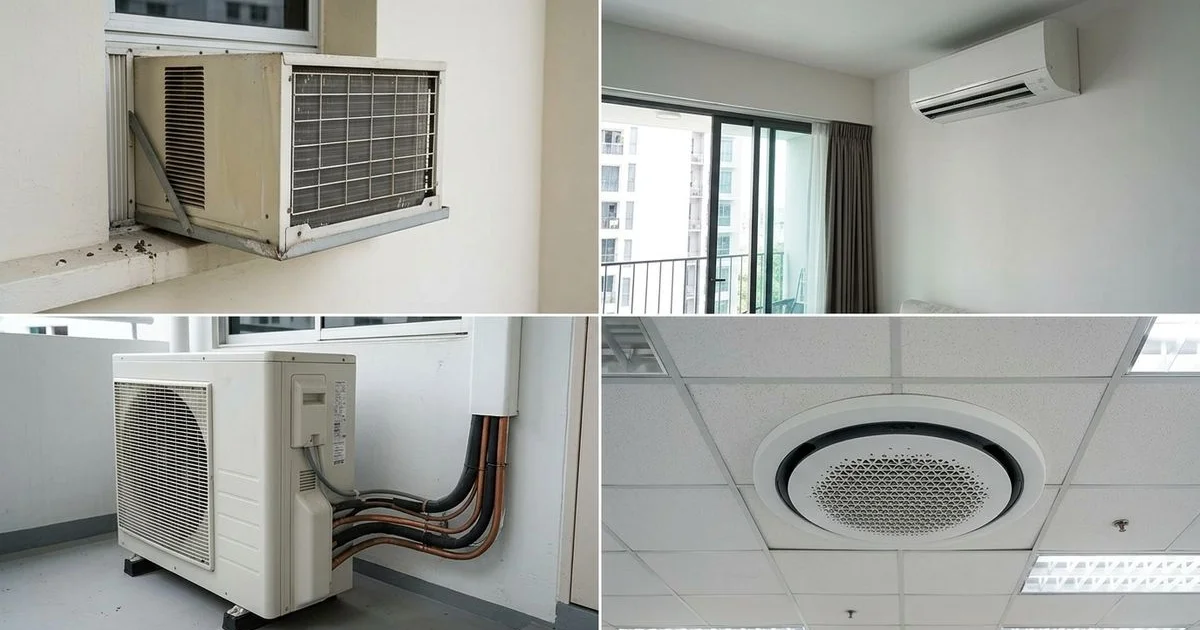
We often see homeowners struggling to match their cooling needs with strict local regulations. Choosing the right system goes beyond just picking a brand.
With electricity tariffs hitting near 29 cents per kWh in 2026, efficiency is absolutely critical.
Our team has handled thousands of installations across HDBs and landed estates. Let’s look at the data and explore the main aircon types Singapore homeowners can choose from.
Four aircon types compared
You have four main choices for residential cooling in Singapore. They range from basic standalone boxes to highly advanced multi-zone networks.
Window units, legacy
Our technicians rarely install these units in modern flats today. If you are weighing a window aircon vs split system, remember that a window unit combines the indoor and outdoor sections into one single chassis. They represent a simple and cheap solution, but they run loud and lack efficiency.
We see prices ranging from $500 to $1,000 for these basic models. Most modern HDB blocks restrict new window installations entirely. You cannot hack a new wall opening just to fit an air conditioner.
Our advice is to check your estate rules carefully. Older blocks might still allow them in specific utility room openings with prior approval.
- Best for: Older blocks with existing designated window openings, and single-room budget setups.
- Not for: Most current HDB and condo installations across Singapore.
Single split, quiet and single-zone
We recommend this setup when you only need to cool a single isolated room. A single split system connects one outdoor compressor to exactly one indoor fan coil unit via copper pipes. The noisy compressor lives outside, keeping your bedroom perfectly quiet.
Our teams frequently install these as standalone additions in older condos. You control that one specific room independently without affecting the rest of the house.
We want to warn you against using multiple single splits for a whole apartment. Every indoor unit requires its own bulky outdoor condenser. This approach quickly clutters your exterior ledge.
- Best for: Single-room cooling, replacing one faulty indoor unit at a time, or dedicated bedroom setups.
- Not for: Cooling multiple rooms from a single outdoor condenser.
Multi-split, most common for Singapore homes
Our top recommendation for typical apartments is almost always a multi-split configuration. When comparing a standard split vs multi split aircon, the main difference lies in exterior space. A multi-split setup connects up to five indoor units to a single outdoor condenser using branched refrigerant lines.
Each indoor fan coil operates independently, giving you precise zone control. This technology is exactly what System 2 / 3 / 4 / 5 refers to in local brochures.
We always check your HDB distribution board limits before quoting these larger systems. Most modern flats run a 40-amp to 60-amp limit, which handles a System 4 perfectly if balanced correctly. Our industry is shifting heavily toward high-efficiency models this year. New National Environment Agency guidelines in 2025 and 2026 strongly promote 5-tick rated multi-split systems to combat rising electricity costs.
- Best for: Typical HDB and condo layouts with 2 to 5 rooms, and modern Singapore homes.
- Not for: Massive properties requiring 10 or more zones, or heavy-duty commercial work.
VRV / VRF, commercial and large residential
We install these advanced networks primarily in multi-story properties and corporate offices. Clients often ask us about vrv vs multi split configurations for large properties. Variable Refrigerant Volume or Variable Refrigerant Flow systems provide sophisticated multi-zone climate control for massive spaces.
The outdoor footprint is larger, but you can add cooling zones modularly as your needs grow. Daikin actually pioneered the VRV concept back in 1986, and the technology has evolved into the ultimate premium choice.
We love specifying these for landed homes in Singapore because they keep the exterior facade clean. Instead of mounting six separate condensers on your walls, one powerful outdoor unit handles everything. Our commercial clients appreciate the precise temperature adjustments these units offer. The system calculates exactly how much refrigerant each room needs in real-time, preventing energy waste.
- Best for: Commercial offices, large landed estates, and complex multi-zone fit-outs.
- Not for: Standard HDBs and condos, as the equipment is massively over-specified for small layouts.
Comparison matrix
We use this exact breakdown during our initial client consultations. Comparing these four systems side-by-side helps clarify which option fits your exact property and budget.
Our goal is to make the technical specifications easy to digest. You will notice that installation costs and energy efficiency scale up together as the systems get more advanced.
| Factor | Window | Single split | Multi-split | VRV/VRF |
|---|---|---|---|---|
| Indoor sound level | Loud (compressor inside) | Quiet | Quiet | Quietest |
| Zone count | 1 | 1 | 2 to 5 | Up to 64 indoor units |
| HDB approval | Very limited | Yes | Yes | Not applicable |
| Condo management approval | Limited | Yes | Yes | Yes |
| Typical install cost | Lowest ($500 to $1,000) | Medium | Medium-high | Highest premium |
| Energy efficiency | Lowest | High | High (when partial load) | Absolute highest |
| Ideal application | Old budget setups | Single isolated bedroom | Most Singapore homes | Large estates or commercial |
Picking by property
We created this quick reference guide to help you match equipment to your floor plan. Matching the correct cooling hardware to your specific property type prevents expensive electrical upgrades later.
Different layouts dictate different compressor limits and piping runs. We strongly advise checking your specific estate guidelines, but these are the standard configurations that work best across Singapore.
- HDB 3-room: System 2 multi-split handles the master and one common bedroom.
- HDB 4-room: System 3 multi-split covers all standard sleeping quarters.
- HDB 5-room / EC: System 3 or 4 multi-split covers bedrooms and the main living space.
- Condo 1-bed: Single split or a small System 2 works perfectly.
- Condo 2-bed: System 2 or 3 balances the load well.
- Condo 3+ bed: System 3, 4, or 5 depending on your master bedroom size.
- Landed (small): A primary multi-split combined with single splits for distant outlier rooms.
- Landed (large): VRV / VRF networks or multiple separated multi-split systems.
- Commercial office: VRV / VRF networks provide the required zoning.
- Shophouse F&B: Multi-split paired with heavy-duty ceiling cassettes.
The inverter question for all types
We consider this the most critical decision for any new installation. Choosing an inverter compressor is the single best way to lower your long-term electricity bills. All four system types listed above are now widely available in both inverter and non-inverter variants.
Traditional non-inverter models run at full blast until the room cools, shut off, and then surge back on again. Our data shows that this constant stop-and-start cycle consumes significantly more electricity. An inverter unit adjusts its motor speed dynamically, maintaining a steady temperature without the heavy power spikes.
We recommend upgrading to an inverter model for three specific reasons:
- Lower Running Costs: They reduce energy consumption by up to 30 percent.
- Faster Payback: With 2026 tariffs near 29 cents per kWh, the savings offset the higher initial price quickly.
- Consistent Comfort: You avoid the drastic temperature swings associated with older units.
The long-term math usually speaks for itself. You can read a detailed breakdown of inverter vs non-inverter aircon for the exact mathematical comparison.
To get an accurate sizing quote based on your specific property layout, see our aircon installation services page. We always conduct a thorough site survey before quoting. This ensures our final recommendation perfectly matches your actual room dimensions, distribution board capacity, and daily usage habits.