How Often Should You Service Your Aircon in Singapore?
Our team often sees residents struggling to determine the correct aircon servicing frequency for their homes.
The reality is that waiting for a breakdown to schedule a service is an expensive and stressful strategy.
National Environment Agency data shows a constant 84% average humidity level year-round, which drastically accelerates mould and dust buildup inside your unit.
We will break down the exact maintenance schedules you need to follow based on real usage data. Let’s examine the three main variables that dictate your timeline and explore exactly what happens during a standard visit.
The default cadence for aircon servicing frequency in Singapore
Quarterly aircon servicing is the established residential standard for HDB and condo units across the island. The three-month cadence directly addresses the constant workload placed on cooling systems here.
Our baseline recommendation stems from the fact that local units do not get a winter resting period. Unlike four-season climates where a compressor rests for six months a year, machines here run hard from January through December. This continuous operation means dust builds up without interruption.
- HDB and condo units: Quarterly servicing manages typical dust and biofilm accumulation.
- Standard office spaces: Bi-monthly or monthly visits suit typical weekday operating hours.
- F&B and heavy retail: Strict monthly servicing combats heavy grease and massive dust loads.
We see efficiency drop significantly if this internal buildup is left unchecked for more than 90 days. The coil, drainage tray, and filter accumulate debris at a steady rate. A prompt three-month cycle clears the obstruction before it costs you efficiency or causes a complete breakdown.
Our commercial clients, including offices and retail stores, require a much tighter monthly schedule. Grease vapour in F&B kitchens and high foot traffic drastically accelerate the accumulation of debris. The maintenance interval shortens to match this heavy load.
Three variables that shift the schedule
The default guideline is not right for everyone. We always assess three distinct variables that can push a property to a tighter maintenance interval. These factors determine how quickly your system degrades under pressure.
System Age and Wear
Units older than five years accumulate debris much faster than brand-new installations. The protective coating on the coil surface degrades over time, allowing biofilm to cling firmly to the metal.
Our technicians frequently recommend shifting from a quarterly to a bi-monthly schedule for these older systems. Internal seals also narrow as the machine ages, which drastically increases the risk of condensation leaks. Catching these wear patterns early stops water from dripping onto your floors.
Daily Operating Hours
The number of hours your compressor runs each day directly dictates your maintenance needs. Operating a unit for less than four hours a day might make a strict quarterly schedule slightly excessive.
We advise clients running their units for over eight hours daily to consider a monthly or bi-monthly check. Server rooms and retail shops running above twelve hours require a strict monthly visit to prevent catastrophic failures. This high-volume usage pulls massive amounts of airborne dust into the filters.
Coastal and High-Humidity Exposure
Waterfront properties in areas like Punggol Northshore, Sentosa, and the East Coast face severe environmental challenges. The combination of sea breezes and high ambient humidity accelerates salt-air corrosion on outdoor condenser fins.
Our teams conduct more frequent chemical washes in these specific zones to combat rapid oxidation. Ground-floor units located near large drainage canals experience a similar heavy humidity load. You should keep the standard servicing quarterly but shorten the deep-cleaning intervals to protect the internal components.
What gets done between visits
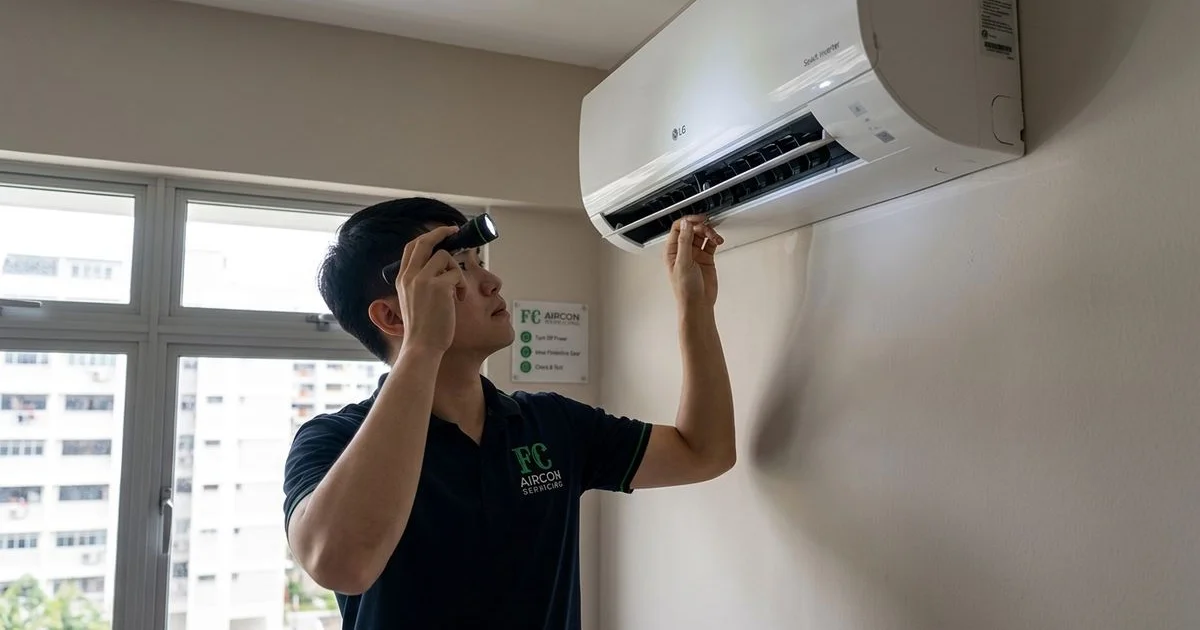
A standard quarterly visit is a preventative measure rather than a complete overhaul. We perform a precise series of diagnostic and cleaning steps to keep the system running efficiently. The process focuses on clearing blockages and verifying that the electrical components are operating safely.
| Check | Time | Technical Metric |
|---|---|---|
| Filter clean and panel wipe | 5-10 min per unit | Restores baseline airflow |
| Evaporator coil surface inspection | 5 min per unit | Checks for biofilm and frost |
| Drainage tray flush and pipe clear | 5 min per unit | Prevents water backflow |
| Refrigerant pressure check via manifold | 5 min per system | Verifies 115-135 PSI (R32 systems) |
| Electrical connection and capacitor test | 5 min per system | Prevents motor burnout |
| Outdoor condenser fin clean | 10 min | Removes trapped heat |
The total time commitment is usually 30 to 45 minutes for each indoor unit, plus an additional 15 minutes for the outdoor condenser. This routine maintenance is strictly preventative work.
Our protocol ensures that minor issues are caught early before they escalate. The deep clean, which involves a chemical wash for the coil itself, is an annual requirement. If you are skipping the annual chemical wash, the quarterly servicing will not reach the hardened buildup that actually matters.
When to compress the schedule
Adjusting your schedule becomes necessary when the system struggles to maintain its baseline performance. We advise property owners to watch for specific warning signs that indicate a heavily congested unit.
The financial impact of ignoring these physical symptoms is measurable and immediate. Pay close attention to the following indicators.
- Weak airflow within six to eight weeks: If the breeze feels weak shortly after a service, the internal blower wheel is likely clogged.
- Musty odours returning quickly: A damp smell returning within two to three months of a chemical wash points to aggressive mould growth in the drainage pan.
- Rising electricity bills: The Energy Market Authority notes that restricted airflow from dirty filters can increase energy consumption by up to 30%. With the SP Group Q2 2026 electricity tariff sitting at 29.72 cents per kWh, a struggling compressor will noticeably inflate your monthly utility costs.
- Owning an older R22 unit: The National Environment Agency has strict phase-out regulations for R22 refrigerants leading up to 2030, making these older systems much harder and more expensive to maintain.
Most homeowners stay on a quarterly cycle indefinitely, and it serves them perfectly well. You must pay attention to the physical signs, as a shortened cadence is much cheaper than replacing a burnt-out fan motor. Our team highly recommends consulting the comprehensive guide on signs your aircon needs servicing if you are unsure about your current system status.
This proactive approach prevents sudden component failures. Securing your ideal aircon servicing frequency is simple with a dedicated service contract.
We handle the scheduling and send automated reminders so you never have to chase a technician. Contract clients also secure priority queue jumping if a sudden breakdown occurs between scheduled visits. Take action today to protect your cooling equipment and keep your home comfortable year-round.