What Is an Aircon Chemical Wash? (And When You Actually Need One)
Living in Singapore means your air conditioner works overtime just to keep the humidity at bay. You probably know the feeling of turning on the unit, only to be greeted by a musty odour or weak airflow.
As a professional service team, we see this exact scenario every single day across the island.
Often, standard maintenance is not enough to clear out the deep-seated grime. That is why understanding exactly what is aircon chemical wash and how it works is vital for protecting your equipment and your indoor air quality.
Let us look at the facts behind this specialized service, what the data tells us about efficiency, and how to decide the right maintenance schedule for your home.
What chemical wash actually is
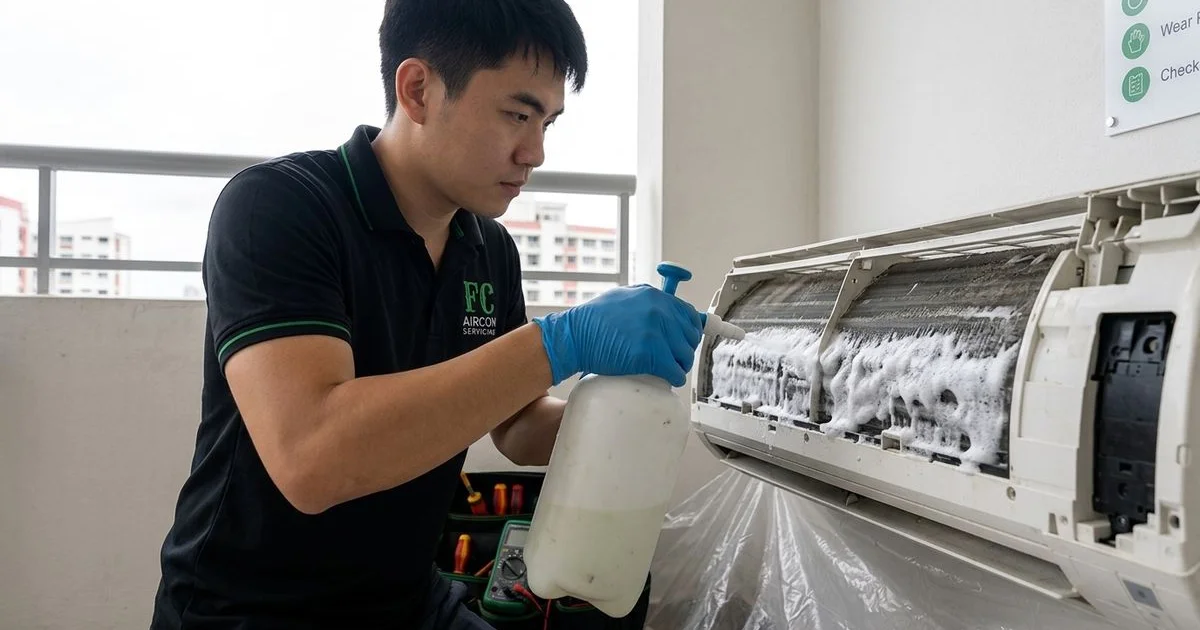
When homeowners ask what is aircon chemical wash, the answer is straightforward. It is a targeted deep clean of the indoor fan coil unit, commonly called the FCU, using an alkaline-based solution.
This specialized liquid is formulated to break down compacted dirt, biofilm, and mineral deposits that regular vacuuming simply cannot remove. We rely on this method because it safely targets the delicate metal components inside the machine without causing corrosion.
The solution is applied as a thick foam directly onto the primary cooling parts. It is left to dwell for 10 to 15 minutes, allowing the active ingredients to dissolve hardened grime.
During the wash, technicians specifically target these core components:
- The aluminium fins of the evaporator coil
- The cylindrical plastic blower wheel
- The internal water drainage pan
- The main PVC drainage pipe
After the dwell time, a high-pressure water flush removes the loosened debris right through your drainage pipe. This job usually takes between one and two hours per indoor unit. Multi-unit visits allow technicians to batch the preparation and finishing work, which keeps the total service time highly efficient.
What gets removed
This deep clean strips away mould, harmful bacteria, hard mineral scaling, and compacted dust from the internal components. Singapore experiences an average humidity of 85%, which practically guarantees biological buildup on your coils within twelve months of daily use.
We frequently find that surface cleaning, like wiping the front panel or washing the basic filters, misses this hidden layer entirely.
The stubborn residue sits directly on the heat exchange coil and the drainage tray below it. Only a chemical reaction can dissolve this grime cleanly without damaging the metal.
Here is exactly what the alkaline solution targets:
- Mould and biofilm: This sticky layer is the most common cause of that musty smell when the unit first turns on.
- Bacteria colonies: Specific bacterial strains thrive in dark, damp drain pans and cause the dreaded sour odour.
- Mineral scaling: Calcium and other hard water deposits from local tap water can harden on the fins over time.
- Compacted dust and skin cells: These particles bypass the primary filter and bond into a restrictive layer on the blower wheel.
Why standard servicing isn’t enough
Standard quarterly servicing is purely preventative and lacks the chemical agents required to dissolve bonded grime. A general service involves washing the primary filters, flushing the drainage pipe with water, checking the refrigerant gas levels, and running a basic electrical test.
What it completely leaves out is the removal of the stubborn layer already attached to the evaporator coil. Even on well-maintained units, nine to twelve months of tropical humidity will create a noticeable film.
We see this buildup force the compressor to work up to 30% harder just to reach your desired room temperature.
Industry Insight: Operating a dirty air conditioner below 23°C forces the compressor into overdrive, which can drastically lower your system’s efficiency and inflate your monthly power bill.
This extra strain directly increases your electricity consumption. Pairing regular check-ups with an annual deep clean is the proven strategy for maintaining peak performance. The combined cadence of quarterly standard servicing plus a yearly chemical wash keeps your air conditioner operating at its rated energy efficiency over the long run.
Signs you’re due
You are due for a deep clean if your unit emits bad odours, shows visible mould, or suffers from weak airflow. Waiting for a complete breakdown is a common mistake that often leads to costly water leaks or complete part replacements.
We advise monitoring your system closely for early warning signs of internal blockage.
You should schedule a professional assessment if any of the following apply:
- A musty or sour smell fills the room the moment the unit powers on.
- Visible mould spots appear around the plastic louvres or air vents.
- The unit produces very weak airflow, even right after you have washed the removable dust filters.
- Your family experiences unexplained sneezing fits or allergy flare-ups when the cooling starts.
- Your monthly electricity bill has crept up noticeably, despite your usage hours remaining completely unchanged.
- It has been more than 12 months since the system last received a chemical treatment.
Frequency by use pattern
The ideal schedule depends heavily on your daily operating hours and the specific location of your property. A guest room used occasionally requires vastly different maintenance than a home office running ten hours a day.
We evaluate each household’s habits to recommend a specific, data-driven timeline.
For properties with pets or residents who smoke indoors, you must shorten these recommended intervals. Airborne fur, dander, and smoke particles coat the internal fins much faster than normal dust.
| Use pattern | Chemical wash cadence |
|---|---|
| Bedroom-only, 2 to 4 hours/day | Every 12 to 18 months |
| Living + bedrooms, 4 to 8 hours/day | Annual |
| Heavy use, 10+ hours/day | Every 6 to 9 months |
| Waterfront / Northshore properties | Every 9 to 10 months |
| Commercial (offices, F&B) | Every 6 months as part of contract |
Wash vs full chemical overhaul
A standard wash cleans the unit in place, while a full overhaul completely dismantles the indoor equipment for component-level scrubbing. The standard wash is the go-to maintenance product for regular upkeep, typically costing between $80 and $130 per unit in Singapore.
The next tier up is a full chemical overhaul, which involves removing the unit from the wall entirely.
An overhaul reaches heavy buildup that a standard foam application simply cannot access. This major service takes three to four hours per unit and generally runs about twice the price of a standard wash.
We find that most residential customers manage perfectly fine by using a staggered approach.
The typical maintenance cycle looks like this:
- Standard Wash: Done annually to clear fresh biofilm and dust.
- Full Overhaul: Reserved for every two to three years for a factory-level reset.
- High-Usage Exception: Overhauls are done more frequently for machines running 12 hours a day or units past five years old.
You can review the specific decision criteria by reading our guide on chemical wash vs overhaul. To secure a maintenance slot, please head over to our chemical wash service page. Multi-unit discounts are applied automatically at checkout, and our existing contract holders receive a further reduced rate.
Keep Your Air Clean and Cool
Maintaining an efficient cooling system in a tropical climate requires proactive care and the right cleaning methods. Knowing exactly what is aircon chemical wash helps you protect your investment, lower your energy consumption, and keep your family breathing easy.
We encourage you to check your current maintenance records today.
If it has been more than a year, reach out to schedule a deep clean and restore your system’s peak performance.