What Actually Happens During an Aircon Chemical Overhaul
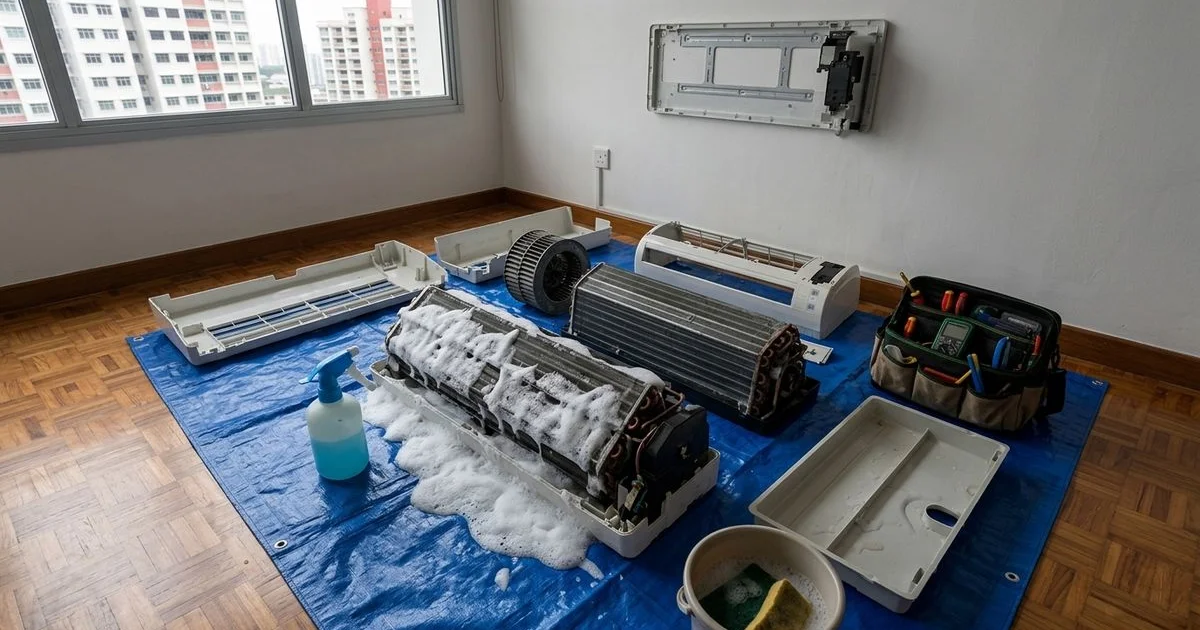
You know how quickly a well-functioning aircon can start blowing weak, musty air after just a few months of heavy use. Singapore’s extreme humidity creates the perfect environment for thick biofilm, or jelly, to grow deep inside your cooling system.
Our technicians see this exact issue causing leaks and airflow problems in homes every single day. A basic surface clean will not reach these hidden mold colonies. The indoor unit must be fully dismantled so each component can be scrubbed individually.
We address this directly with a chemical overhaul, the deeper-cleaning tier above a standard wash.
Fresh sealants are applied during reassembly to ensure everything runs perfectly. Let’s look at the exact aircon chemical overhaul process, the time it takes, and how you can prepare your home for the appointment.
The full overhaul workflow
The full aircon chemical overhaul process requires fully dismantling the indoor unit to scrub each part individually. Most full treatments run about two to four hours per indoor unit from start to finish. Our team follows these exact chemical overhaul steps for every single job.
Step 1: Pre-arrival prep
Proper aircon overhaul prep ensures the appointment starts smoothly without any delays. You should move fragile electronics and furniture away from the space directly below the unit. We bring all the necessary protective gear, plastic sheeting, and specialized tools.
Clearing the workspace saves about 15 minutes of setup time right out of the gate. This small step helps the technicians get straight to the actual cleaning. Our crew will handle any minor adjustments needed upon arrival.
Step 2: Setup and waterproofing (15 minutes)
Water damage is a major concern during any intensive cleaning procedure. Heavy-duty plastic sheeting is laid down to protect your flooring and nearby walls. We isolate the electrical supply at the breaker box before any water is introduced.
A massive amount of high-pressure water is required to flush out the disassembled parts. The waterproofing barrier catches all the contaminated runoff securely. Our standard procedure ensures your room stays completely dry throughout the entire 2026 servicing appointment.
Step 3: Indoor unit dismantle (20-30 minutes)
Removing the front cover provides access to the core internal components. The louvres, drainage tray, blower wheel, and evaporator coil are carefully extracted. We lay each piece out on the protective sheet in the exact order of removal.
Different brands like Daikin and Mitsubishi use specific plastic latches that can snap easily. Trained hands are required to unclip these delicate parts safely. Our technicians map out the reassembly sequence to guarantee a flawless fit later.
Step 4: Component scrub (60-90 minutes)
The blower wheel is usually the worst offender for trapping dirt and mold. Surface washing simply pushes the grime deeper into the metal fins. We scrub every single surface individually using a specialized, metal-safe alkaline solution.
The drainage tray is thoroughly descaled to remove the thick jelly buildup common in tropical climates. A close inspection often reveals tiny hairline cracks in older trays. Our team points out any damaged parts immediately so you can make an informed decision on replacements.
Step 5: Coil flush (15-20 minutes)
The wall-mounted coil receives a direct blast of high-pressure water. The rinsing continues until the runoff liquid turns completely clear. We test the primary drainage path during this flushing stage.
Algae clogs in the condensate pipe are a leading cause of leaking aircons in Singapore. Clearing this pathway prevents future water from spilling down your walls. Our equipment forces the remaining debris out of the line safely.
Step 6: Reassembly with fresh sealants (20-30 minutes)
Putting the system back together happens in the exact reverse order. The original foam sealants on the cover gasket often harden and degrade over time. We install fresh sealing foam to prevent condensation leaks from forming around the casing.
The drainage tray is firmly re-seated into its proper position. A secure fit here stops water from bypassing the pan entirely. Our final visual check confirms that all structural clips are locked tight.
Step 7: Test cycle (15 minutes)
Power is restored at the breaker box to initiate the final test run. The machine needs to operate for at least 15 minutes to stabilize the cooling cycle. We use digital thermometers to verify the discharge air is consistently 8 to 12 degrees Celsius cooler than the room temperature.
The drainage flow is monitored one last time to ensure gravity is doing its job. Any rattling or unusual motor noises will be investigated instantly. Our job is only complete when the system sounds smooth and feels freezing cold.
Total time and what you can expect
You can expect the total aircon overhaul time to range from two hours for a single unit up to seven hours for four units. The size of your home and the number of cooling units directly dictate the total duration. We generally schedule full overhauls well in advance because they demand a much longer slot than a basic service.
| Unit count | Total time |
|---|---|
| 1 indoor unit | 2-3 hours |
| 2 indoor units | 3-4 hours |
| 3 indoor units | 4-5.5 hours |
| 4 indoor units | 5-7 hours |
A typical four-room HDB flat usually runs on a System 3 configuration. The technician will arrive early in the morning and wrap up by mid-afternoon. Our dispatch team updates you if the job finishes earlier than projected.
You do not have to hover over the workspace while the cleaning happens. Many clients choose to work in another room until the final test cycle begins. We always provide a clear wrap-up report before leaving the property.
When overhaul is worth the time
An overhaul is worth the time and cost when a standard wash fails to fix persistent smells, weak airflow, or heavy mold. A basic surface cleaning works well for minor dust, but heavy contamination requires stripping the system down. We recommend the full teardown process when you notice specific, stubborn performance issues.
An overhaul makes more sense than a wash when:
- The unit is five or more years old with heavy daily use.
- Symptoms like sour smells or weak airflow returned within two to three months of a previous wash.
- Visible coil buildup exists beyond what a surface chemical wash can dissolve.
- The drainage tray shows hairline cracks or heavy mineral scale.
Lighter dust accumulation on younger machines does not always require this level of intervention. The standard chemical wash is often the right choice for those minor situations. Our regular maintenance plans suggest a basic wash annually and a full teardown every two to three years.
Pricing for these comprehensive jobs depends on the specific brand and configuration of your home. You can review all the exact costs and exclusions by checking the aircon chemical overhaul price guide to start the aircon chemical overhaul process. We update those figures regularly to reflect the current 2026 market rates, so book your appointment today to restore your cooling efficiency.