Quarterly vs Monthly Aircon Service Contracts — Which Fits You?
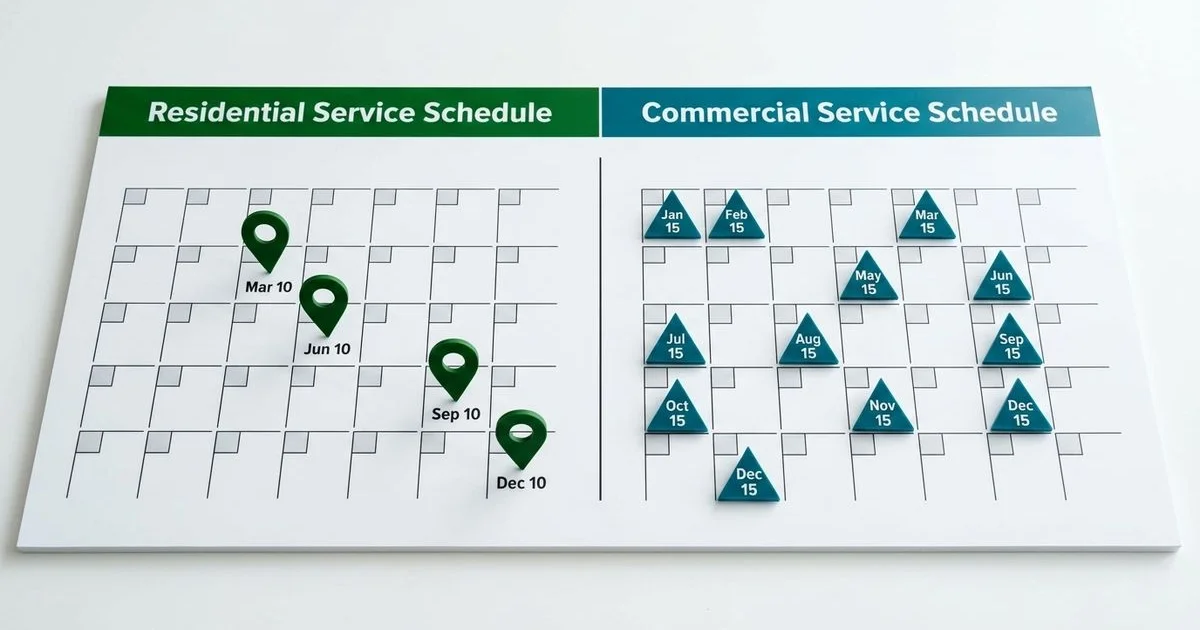
Our professional service team fields this scheduling question almost every single day.
Deciding between a quarterly vs monthly aircon servicing routine is the dividing line between an efficient cooling setup and a constant headache. Start by matching your maintenance frequency directly to your daily usage patterns.
We find that Singapore’s intense 80% humidity levels force equipment to work significantly harder than manufacturer baselines suggest. Local performance data provides a much better guide than generic instruction manuals. Both cadences are available under our Aircon Service Contracts, with property-type pricing bands. Read the usage data, what the National Environment Agency (NEA) recommends, and a clear plan for your property below.
The default by use type
Quarterly servicing is the standard baseline for most standard residential setups in Singapore. Upgrading to a monthly schedule is strictly necessary for commercial spaces or heavy usage scenarios running over 10 hours a day.
Our technicians follow the National Environment Agency (NEA) baseline recommendation to service units every three months. This quarterly cadence perfectly matches Singapore’s year-round humidity load, which often exceeds 80%.
We use the table below to quickly map typical property profiles to their ideal maintenance schedule. Check your specific usage pattern against these standard benchmarks.
| Use pattern | Right cadence |
|---|---|
| Standard residential (3-8 hr/day) | Quarterly |
| Heavy residential (10+ hr/day, server room) | Monthly |
| Commercial office | Monthly |
| F&B kitchen | Monthly |
| Retail / shophouse | Monthly |
| Vacation property | Quarterly (or twice yearly) |
Our experience shows that most standard homeowners do not need to overspend on monthly visits. Sticking to a quarterly aircon contract ensures your system stays clean without wasting money on unnecessary appointments.
When to step up from quarterly to monthly
You should upgrade to a monthly aircon contract if your unit runs more than 10 hours daily, operates in a high-risk zone, or struggles with heavy indoor pollution. These five specific signals indicate that a quarterly schedule leaves your equipment exposed to rapid wear and tear.
Our crews look for specific environmental triggers that dictate a faster servicing timeline. Catching these issues early prevents severe damage and keeps your indoor air quality safe.
1. Aircon runs 10+ hours daily
If the living room unit is on from 8am to 11pm every day, the cumulative load mimics a commercial environment. The National Environment Agency’s recent “Go 25” campaign highlights that running units constantly to fight heat creates excessive strain.
Our data shows that coil buildup accelerates significantly past the eight-hour mark. Upgrade to monthly visits to clean the blower wheel and prevent moisture from trapping dust inside the system.
2. Multiple occupants, all-day at home
Work-from-home households with family members present all day generate a continuous cooling demand. A quarterly schedule often leaves the evaporator coil dirty for too long under these conditions.
We frequently see reduced cooling efficiency in crowded homes because human activity stirs up indoor particulate matter. You need a monthly cleaning to clear this dust before it severely restricts airflow.
3. Pets, smokers, or heavy cooking
Indoor air carries higher levels of particulate matter from pet dander, cooking oils, and smoke. These airborne particles bond with condensation to form a thick biofilm inside your drainage pipes.
Our technicians call this sticky substance “aircon jelly”, and it is a leading cause of water leaks in Singapore homes. Monthly servicing catches this jelly buildup before it clogs the drain line and ruins your expensive vinyl flooring.
4. Older units (8+ years)
As internal surfaces roughen and rubber seals soften, an aging unit requires constant attention. Wear and tear cause parts to degrade faster, making older units highly susceptible to sudden electrical or mechanical failures.
Our teams use monthly visits to monitor early-warning signs on failing components. Replacing a damaged PCB board in 2026 can cost anywhere from $350 to $900, making frequent preventative checks a smart financial choice.
5. Critical zones: server rooms, dental clinics, food prep
Where equipment downtime carries severe financial or operational consequences, a monthly schedule is mandatory. Catching a minor issue a month earlier prevents a catastrophic breakdown that costs your business 24 to 48 hours of operation.
We prioritize these high-risk areas because stable temperature control is non-negotiable for servers and sensitive materials. Protect your critical assets by maintaining a strict, frequent maintenance protocol.
When monthly is overkill
Monthly servicing is an unnecessary expense for bedrooms used only at night or newly installed units running efficiently. A standard quarterly aircon contract easily handles the maintenance needs for moderate, everyday usage.
Our service logs show that light usage simply does not generate enough dirt to justify a 30-day cleaning cycle. New Build-To-Order (BTO) flats equipped with modern R32 refrigerant systems run exceptionally clean during their first two years.
We advise against over-servicing if your property matches these low-impact profiles:
- Bedroom-only use, running 4 to 6 hours daily
- Newly installed BTO units within their first 24 months
- Vacation properties requiring just twice-yearly checks
- Single-unit installations with light weekend usage
Our quarterly plans cover these scenarios perfectly. Save your budget for major repairs later down the road instead of paying for redundant cleanings now.
The price-per-visit math for quarterly vs monthly aircon servicing
A quarterly contract for a standard three-unit home costs roughly $120 to $200 per year, breaking down to about $30 to $50 per visit. Commercial monthly setups command higher annual fees but offer a lower cost per individual visit due to scaled logistics.
Our pricing models reflect updated 2026 Singapore market averages for both residential and commercial services. The total annual expense depends heavily on the number of units and the complexity of the internal components.
We break down the numbers to help you budget accurately. Review the standard rates below to see how the per-visit cost shifts based on your tier.
| Service Tier | Annual Cost Estimate | Equivalent Per-Visit Cost |
|---|---|---|
| Residential Quarterly (3 units) | $120 to $200 per year | $30 to $50 |
| Small Commercial Monthly | $250 to $300 per year | $20 to $60 |
| Large Office VRV/VRF Monthly | $1,500 to $3,000 per year | $80 to $200 |
Our logistics team calculates that getting to the property represents the main fixed cost. Doing more work once on-site makes the per-visit rate significantly cheaper for high-frequency monthly commercial accounts.
Switching tiers later
You can easily adjust your service frequency at contract renewal or mid-term by providing a 30-day notice for pro-ration. Shifting from a quarterly to a monthly plan is a simple administrative update as your household needs change.
Our residential customers often start on a quarterly schedule and upgrade to monthly after a lifestyle shift, like welcoming a new baby or switching to remote work.
Monitor your unit’s performance closely and upgrade immediately if you notice weaker airflow or musty odours.
We handle these transitions smoothly without penalizing your existing agreement. For specific details on structuring commercial setups, see our aircon contract for HDB, condo, and commercial guide.
Our priority is making sure your cooling system matches your actual lifestyle requirements. Choosing correctly between quarterly vs monthly aircon servicing keeps your home cool, efficient, and comfortable all year round.
We highly recommend reviewing the facts before making your final decision. Explore the broader financial picture by reading our breakdown on whether a service contract is worth it before booking your next appointment.