Commercial Aircon Downtime — How to Minimise Operational Disruption
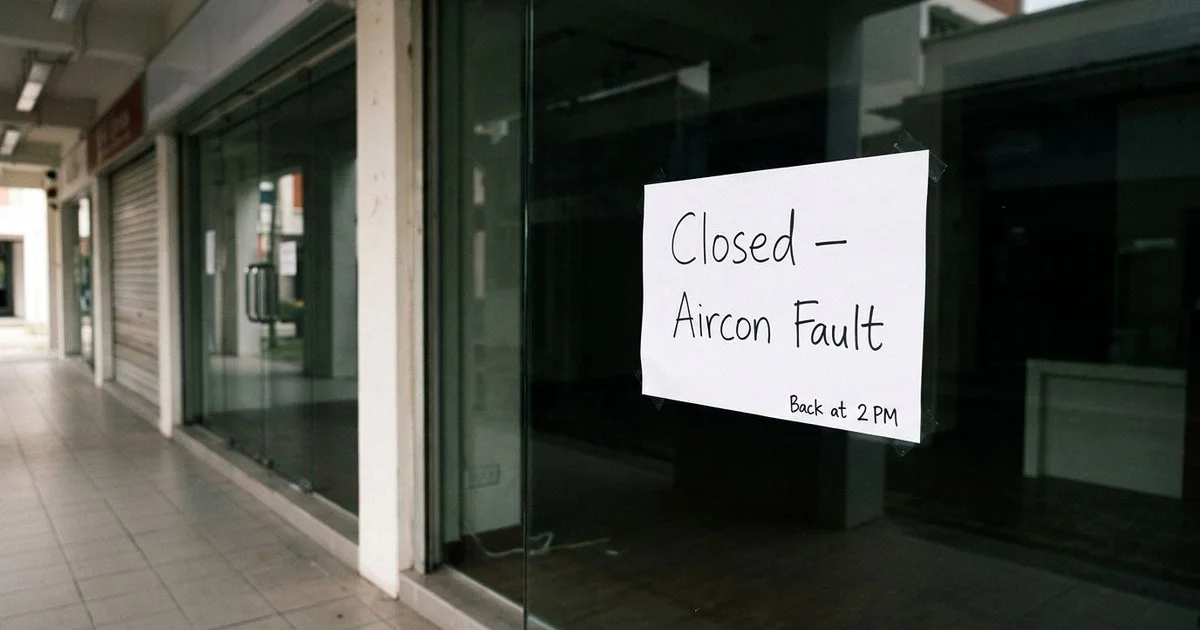
You know how quickly a single disrupted afternoon can cascade into a full week of operational chaos. We see commercial aircon downtime drain profits from Singapore businesses every single month. The reality of an outage goes far beyond sweaty employees.
Our priority is to help you map out the exact aircon downtime cost before it happens. Let us look at the real financial impact across different sectors. The right Priority commercial contracts offer a highly practical safeguard for your daily operations, and the system-specific scheduling tips in VRV/VRF Maintenance for Offices keep zone-by-zone work from disrupting trading hours.
What downtime actually costs
Calculating the true cost of an aircon failure depends heavily on your exact business type. Our technicians track these incidents closely across the island. The financial figures often surprise facility managers.
Office (general)
Productivity drops noticeably in an office setting, even if it is not a complete work stoppage. We frequently see cases where a two-hour outage triggers a mass work-from-home order. According to 2025 data from ITIC, general IT and office downtime can cost small enterprises around $5,600 per minute in lost output.
- Direct loss: Workers stay in the building, but overall output drops significantly.
- Per-hour cost: Small offices lose $50 to $200 per hour, while large corporate spaces lose $500 to $2,000 per hour.
- The tipping point: Staff will generally tolerate 1 to 2 hours of heat.
- Compliance risk: Overheating server racks can lead to breaches, risking a Personal Data Protection Act (PDPA) fine of up to $1 million.
Retail (general)
Shoppers simply will not stay in a warm, stuffy store. Our maintenance crews notice that peak hour downtime in a Singapore mall directly kills daily footfall. A 2026 industry survey indicates a 37 percent drop in revenue generation capability during these retail outages.
- Direct loss: Customers abandon their shopping immediately.
- Per-hour cost: Retailers lose $200 to $1,500 per hour during peak weekend times.
- The tipping point: You lose customers incredibly fast during a heatwave.
F&B kitchen
Food safety is the biggest vulnerability for any restaurant. We often arrive at kitchens where service has been completely halted to protect inventory. The Singapore Food Agency (SFA) strictly regulates the temperature danger zone, which falls between 5°C and 60°C.
- Direct loss: Kitchens must stop service, and food safety becomes an immediate health risk.
- Per-hour cost: Busy services drop $500 to $3,000 per hour in unfulfilled orders.
- The tipping point: A kitchen usually has to close within 30 to 60 minutes of the dining area system failing.
- Safety limit: Hot food cannot sit below 60°C for more than 4 hours under SFA rules.
Server room and data centre
Thermal shutdowns happen in a matter of minutes, not hours. Our emergency callouts to data centres reveal how expensive these disruptions truly are. A recent New Relic report shows that business outages in the ASEAN region cost an average of $2.5 million per hour.
- Direct loss: Sensitive equipment sustains permanent damage, causing a complete service outage.
- Per-minute cost: Large enterprise data centres can lose up to $9,000 per minute during a failure.
- The tipping point: You only have minutes to react, making redundancy completely mandatory.
How a commercial aircon SLA reduces expected downtime
A reliable commercial aircon SLA is the best defense against unexpected closures. Our priority agreements reduce your expected operational pause in three distinct ways. These service tiers are designed to keep businesses running smoothly during the hottest months.
1. Faster response
Standard ad-hoc dispatch during a peak summer week usually takes 3 to 6 hours. We guarantee a 2 to 4 hour response time for priority contract holders, depending on your exact tier. This rapid deployment effectively cuts your waiting period in half.
2. Preventative catch
Monthly maintenance catches small issues well before they trigger a catastrophic failure. Our teams routinely spot slow refrigerant leaks, weakening compressor capacitors, and blocked drainage pipes. A 2025 study by Siemens found that this type of preventative catch reduces unplanned facility downtime by up to 65 percent. Fixing a part during a scheduled visit is always cheaper than an emergency dispatch.
3. Redundancy planning
Higher-tier contracts actively include redundancy design. We build backup capacity into your most critical zones, ensuring a single component failure never takes the entire area offline. This N+1 redundancy model is standard practice for mission-critical infrastructure.
SLA tiers and what is available
Choosing the right tier depends entirely on your risk tolerance. We provide four distinct levels of coverage to match different commercial needs. Higher tiers do not change the actual scope of the work. They simply change the response speed and guarantee your dedicated dispatch availability.
| Tier | Response time | Cost premium | Use case |
|---|---|---|---|
| Standard contract | Same or next day | Baseline | Most standard offices |
| Priority | 4-hour on-site | +20% | Retail spaces and mid-size F&B |
| Critical | 2-hour on-site | +40% | Large F&B and critical retail |
| Maximum response | 1-hour on-site (24/7) | +60% | Server rooms and major F&B |
After-hours and pre-planned servicing
The single biggest lever you have to minimise aircon downtime is scheduling maintenance outside of operating hours. We build this after-hours access directly into our higher-tier contract pricing. It is also available as a per-visit addition for baseline tiers.
Industry-specific maintenance windows
Different commercial spaces require completely different access times. We align our visits with your building management system rules to avoid any noise complaints. Here are the most common time slots utilised in Singapore.
- F&B outlets: The standard window is 11pm to 6am on Sundays. We arrive at lock-up, finish the work, and leave before your opening prep begins.
- Retail stores: The ideal times are Sunday evenings or pre-opening hours between 6am and 9am, provided your lease terms allow it.
- Office buildings: Maintenance happens after 7pm on weekdays or throughout Saturdays. We find this especially critical for extensive VRV system servicing.
Redundancy for critical zones
Some zones simply cannot accept any level of service interruption. We strongly advise designing these safeguards during your initial installation or a major refit. Retrofitting a redundancy system without a planned outage is highly disruptive. It is the kind of engineering work that is significantly cheaper during the fit-out stage than it is later on.
Proven backup strategies
A reliable backup plan requires the exact right hardware configuration. We deploy three primary methods to protect high-stakes environments. Each option provides a different level of immediate protection.
- Cross-tied VRV loops: This setup connects two outdoor condensers to feed the same indoor zones, providing an automatic failover mechanism.
- Dedicated split backup: A completely standalone unit remains powered off but ready to cover the area when the main system fails.
- Mobile portable units: These are kept on-site as immediate emergency cover. We recommend keeping these near a dedicated Uninterruptible Power Supply (UPS) for critical server rooms.
How to estimate your downtime exposure
Understanding your financial risk requires a very straightforward calculation. Our consultants use a simple formula to help businesses see their exact vulnerability. Start by answering three quick questions about your daily operations.
- What is our hourly revenue or overall productivity value?
- How long after an aircon failure must we completely stop working?
- What is the typical Mean Time to Resolve (MTTR) on our current setup?
Multiply your hourly revenue by your response time, and then multiply that by your downtime probability per year. We find that this annual expected cost is almost always higher than the price of a preventative agreement. Compare that final number against the cost premium of a priority commercial contract.
To set up a commercial agreement with the right SLA tier for your business, see our commercial aircon services page. We encourage you to review the deeper mechanics of the priority queue by visiting our priority aircon servicing guide. Securing the correct response time today will save you from massive headaches tomorrow.